Getting around Chamonix: buses, the Mont-Blanc Express train, ski shuttles and bikes
A valid lift pass makes the bus free, the guest card does not. The Chamonix Mobilité network, the Mont-Blanc Express train, shuttles to the ski areas, cycling, taxis, wheelchair access and the official route map.
The Chamonix valley stretches for about twenty kilometres, from Les Houches to Vallorcine, and its ski areas are scattered all along it. The centre is easy on foot; everything else means a bus, a train or a car.
The good news: with a valid lift pass, the valley bus costs nothing. The bad news: the guest card you are given on arrival is not a travel ticket, and that is the most common visitor mistake. Here is the full guide, 2026 fares included.
The map below is drawn by Chamonix365 from OpenStreetMap data: the main lines, their terminuses and their connections. You can download it and keep it on your phone.
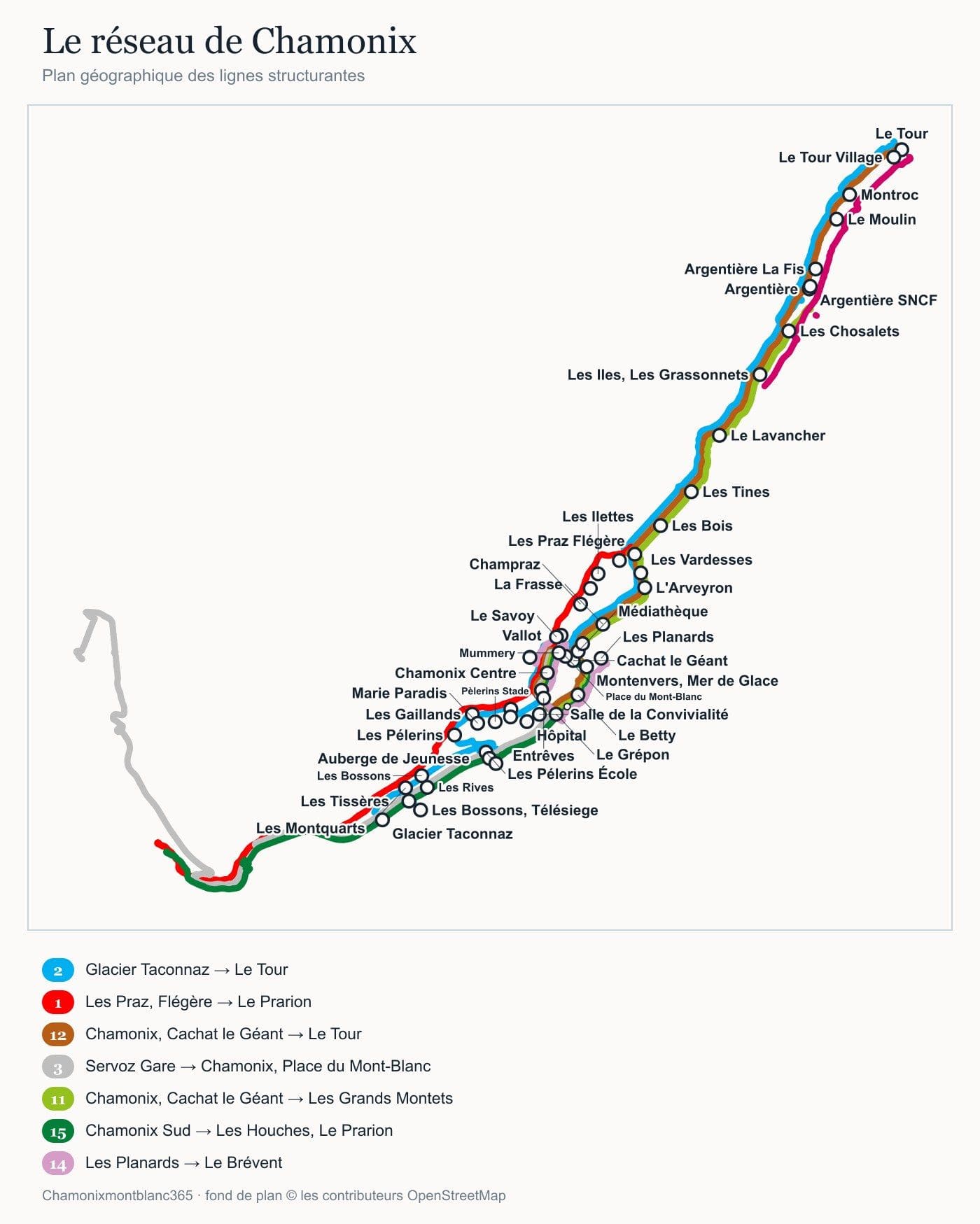
Download the network map (JPG, 214 KB) ↓
The official, complete and up-to-date map is the operator's: Chamonix Mobilité.
Download the official map: Chamonix Bus winter guide 2025-2026 (network map and timetables) (PDF) ↓
Download the official map: Chamonix Bus summer guide 2025 (network map and timetables) (PDF) ↓
The line on the map follows the Mont-Blanc Express, from Saint-Gervais to Vallorcine, free with the guest card between Servoz and Vallorcine.
Our tip: Buy your bus tickets in advance rather than on board: €1.70 instead of €2.20, and you board faster at peak times.
How does the Chamonix Mobilité bus work?
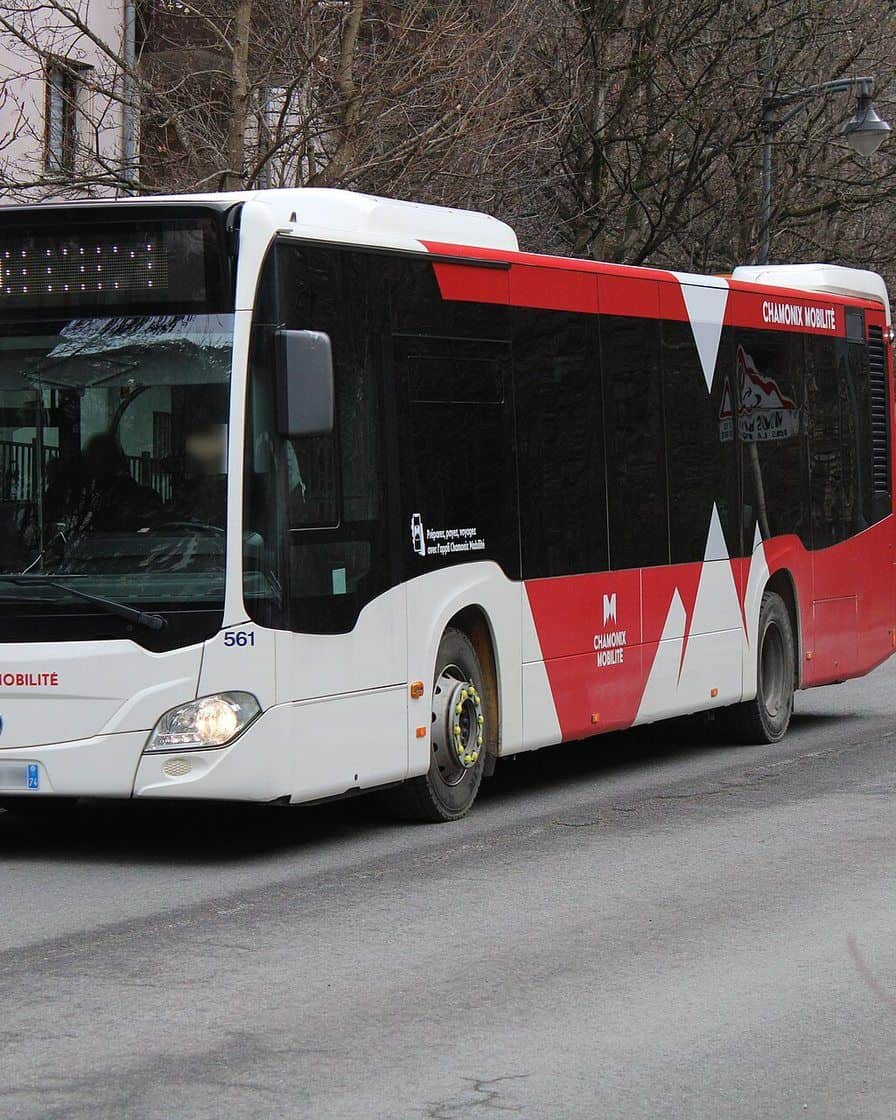
Photo: Anthony Levrot, CC BY-SA 4.0, via Wikimedia Commons
The Chamonix Mobilité network serves the length of the valley, from Servoz and Les Houches to Le Tour, via the centre, Les Praz and Argentière. It has 9 Skibus lines in winter to the foot of the slopes, 3 lines in summer including 2 equipped for bikes, an electric town-centre shuttle, night services, and Mobil'bus, the door-to-door on-demand service for people with reduced mobility.
The OpenStreetMap survey gives an idea of the main lines, to be confirmed in the season's guide:
- Line 1: Les Praz to Le Prarion, via the centre and Les Houches.
- Line 2: Taconnaz to Les Grands Montets and Le Tour, the whole length of the valley.
- Line 3: Servoz to Chamonix.
- Lines 11 and 12: Chamonix to Les Grands Montets and to Le Tour.
- Line 14: Les Planards to Le Brévent, and line 17: the Grépon to Le Brévent.
- Line 15: Chamonix to Les Houches.
The lift stations, train stations and villages these lines connect are placed on our map of Chamonix.
Where can you find the official bus map and timetables?
Chamonix Mobilité publishes a guide each season, with the network map and line-by-line timetables. The latest winter guide online is for the 2025-2026 season and the summer guide is for 2025: they are the only operator maps available as we write.
- Chamonix Bus winter guide 2025-2026, map and timetables (PDF, chamonix.com)
- Chamonix Bus summer guide 2025, map and timetables (PDF, chamonix.com)
For the autumn, the current guide runs from 7 September to 18 December 2026. The edition covering the heart of winter 2026-2027 had not yet been published: do not rely on a previous season's timetable for a last bus back.
How much does the bus cost in Chamonix?
| Ticket | 2026 fare | Conditions |
|---|---|---|
| Ticket bought in advance | €1.70 | before boarding, or in the app |
| Ticket bought on board | €2.20 | cash, according to the source |
| Day ticket | €5 | one day |
| Group day ticket | €10 | 3 to 5 people |
| 3-day pass | €9 | consecutive days |
| Weekly pass | €19 | €39 for a group of 3 to 5 |
| Monthly pass | €29 | annual pass €290 |
| Under 4s | free | |
| Valid lift pass | free | the lift pass is your travel ticket |
Buying on board costs 50 cents more per journey. Over a week with two journeys a day, that is €7 wasted, almost the price of the three-day pass.
Is the guest card enough to take the bus?
No. The guest card is given free by your accommodation on arrival and entitles you to discounts, often half price, but it does not let you board the bus on its own. You have to buy a reduced-fare ticket, or hold a valid lift pass.
The guest card page publishes its own price list: €5 for two days, €6 for three days, €7 for four days, €8 for five days, €10 for seven days and €20 for fourteen days, the last one sold only at the Maison de la mobilité.
This list does not match the network's: it shows €9 as the reference price for two days and €18 for a week, whereas the general list gives €9 for three days and €19 for a week. They may be different products, but the sources do not settle it. Check at the point of sale.
- The single ticket has no guest card discount.
- Discounts do not apply on night buses after 9pm.
- Each traveller needs their own card, except children under 4.
- A booking confirmation or a screenshot does not replace the card.
How do you use the Mont-Blanc Express train in the valley?
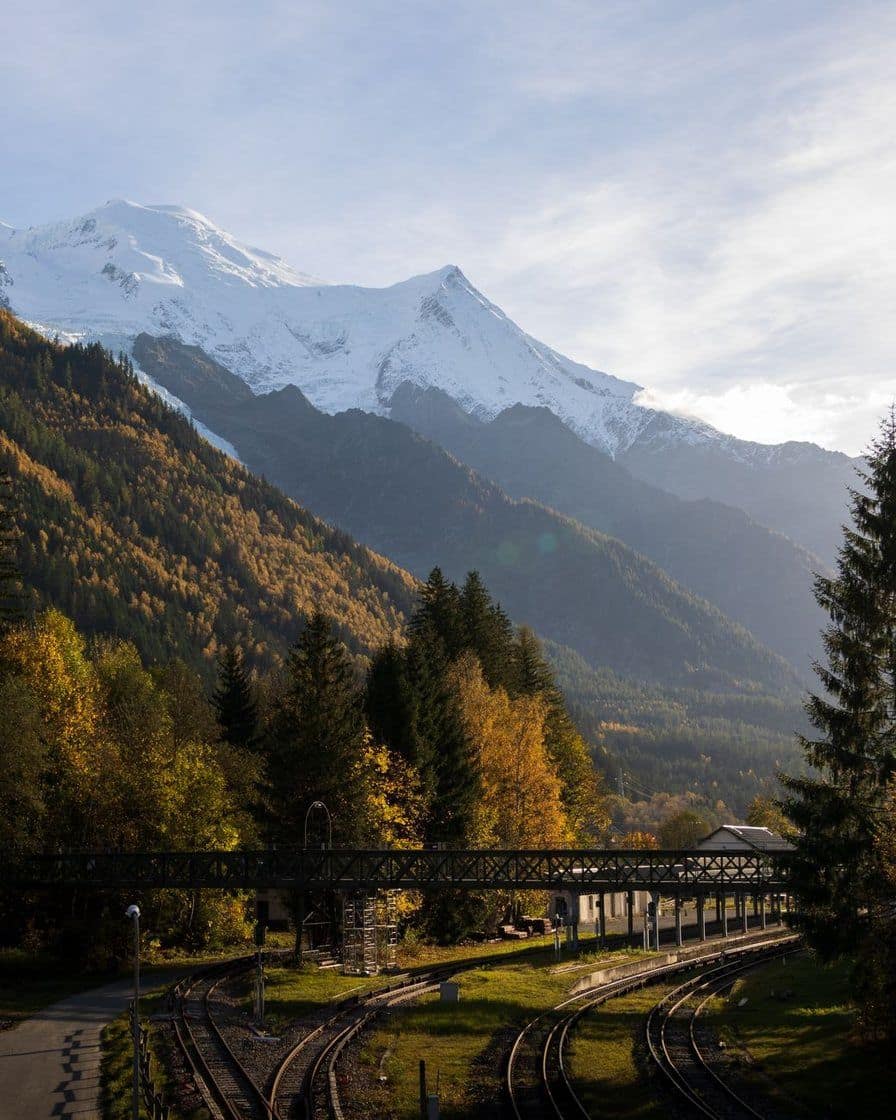
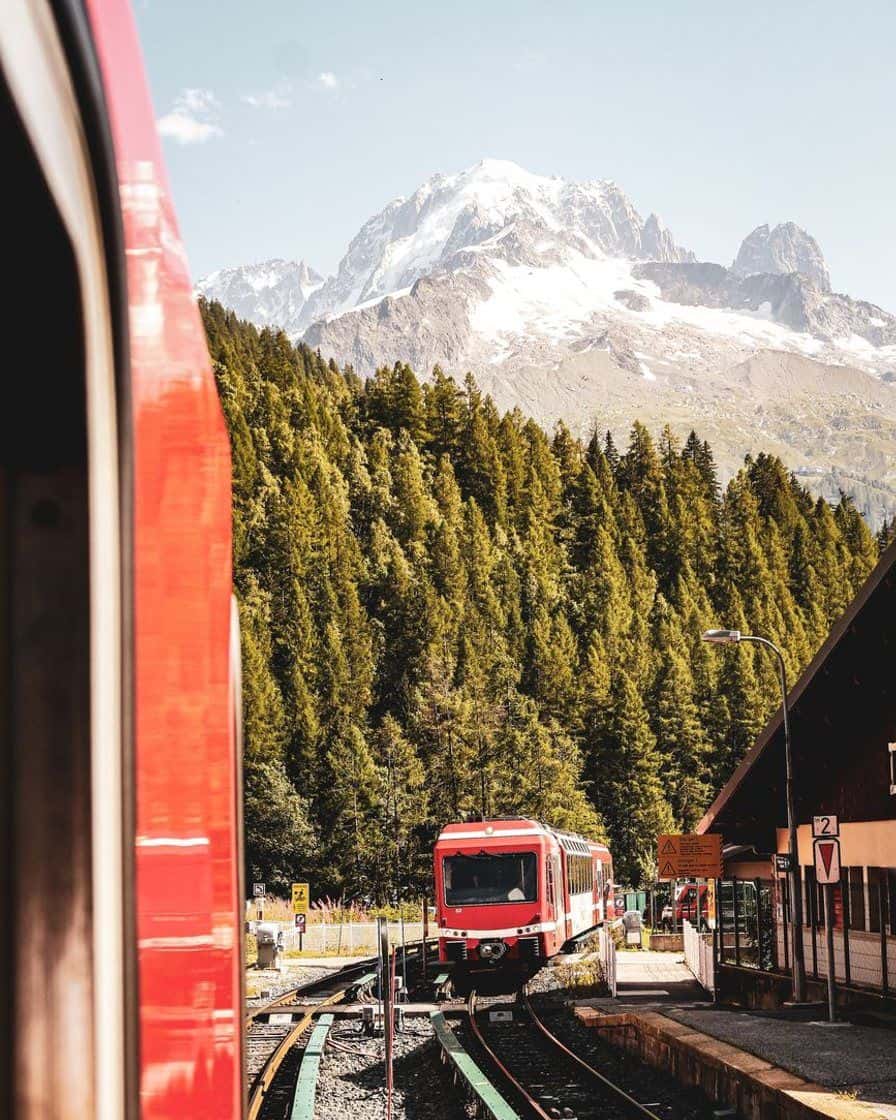
The train serves the valley villages in both directions: west to Saint-Gervais-Le Fayet via Les Bossons, Les Houches and Servoz, and east to Martigny, in Switzerland, via Les Praz, Argentière and Vallorcine.
With the guest card, the journey is free between Servoz and Vallorcine. Beyond that, towards Saint-Gervais or Switzerland, you have to buy a ticket, at the station ticket office or on the SNCF Connect app.
The published timetable period runs from 14 September to 12 December 2026. The train is not a metro: it links stations, not lifts, and you often still need to walk or take a bus at the end. Check the day's timetable in case of snow or engineering works.
How do you reach the ski areas without a car?
The 9 Skibus lines are the backbone of a car-free ski holiday, and a valid lift pass makes them free. The plan is simple on paper: line 2 or 11 for Les Grands Montets, line 2 or 12 for Le Tour, line 14 or 17 for Le Brévent, line 1 or 15 for Les Houches.
In practice, check five things before relying on a shuttle:
- that the ski area you want is open that day (see lift opening dates);
- where the shuttle really stops, and how far you still have to walk in ski boots;
- space for skis and pushchairs;
- the time of the last bus back;
- cancellations announced for a snowy road or a closed lift.
No occupancy figures are published. A shuttle that looks frequent on paper can be full at 9am during the February holidays: set off early. Choosing a ski area for your level is covered in our guide to skiing in Chamonix.
The best travel ticket is your address. Accommodation a few minutes from a station or a Skibus stop spares you the car for the whole stay. In Les Praz, the station and La Flégère gondola are within walking distance.
See places to stay in Chamonix →See places to stay in Les Praz →Partner links: booking through them supports the site at no extra cost to you.Can you get around by bike and on foot?
On foot, yes, in the centre: the station, the shops, the Aiguille du Midi and Le Brévent are within walking distance. Not beyond: Les Houches, Argentière and Vallorcine are several kilometres away, with some climbing.
In summer, two bus lines are Vélobus services equipped to carry bikes. Spaces are limited: aim for off-peak times with a heavy e-bike. In winter, cycling becomes marginal: slippery roads, snow and bike routes that are rarely cleared.
When should you take a taxi or keep the car?
A taxi makes sense for an arrival after the last bus, lots of luggage and skis, accommodation far from a stop, or a wheelchair. Ask for a written quote, stating luggage, skis and time, and book the day before for a very early departure.
The car is more flexible for the hamlets and late returns, but in season it piles up the drawbacks: slow traffic, winter equipment depending on conditions, full car parks near the lifts. The centre has pedestrian streets and bollards: do not count on dropping your passengers outside every hotel. Car parks are covered in parking in Chamonix.
How do you get around with reduced mobility?
The most practical service is Mobil'bus, door-to-door transport on demand, run by Chamonix Mobilité. Book it before you arrive, by phone with Chamonix Mobilité, and get written confirmation of the vehicle, ramp, and wheelchair dimensions and weight.
For regular buses and the train, there is no list of accessible platforms or low-floor vehicles. Snow piled up at stops, uneven pavements and platforms that do not line up remain the real obstacles.
Which transport traps should you avoid?
- Taking the guest card for a ticket. It gives you a discount, not a journey.
- Forgetting to validate. Validation is compulsory every time you board, passes included, and inspections take place on board.
- Relying on the app alone. It sells reduced-fare tickets, but a foreign card or phone number can block the purchase. Keep some euros in cash and a ticket bought in advance.
- Trusting the last bus time without checking it. Timetables change with the holidays, the opening of the ski areas and the snow.
How to get to Chamonix from Paris, Lyon or Geneva is explained in how to get to Chamonix and Geneva to Chamonix.
The right habit, in one sentence
Ask for the guest card on arrival, download the app before you leave, buy tickets in advance rather than on board, validate every time you board, and keep your lift pass on you: it is what makes the bus free.
The other useful information for your stay, from left luggage to pharmacies, is in practical services in Chamonix and the Practical section.
Without a car, sleep near the train. The stations of Chamonix, Les Praz, Argentière and Les Houches are linked by the Mont-Blanc Express, free between Servoz and Vallorcine with the guest card your accommodation provides.
Compare places to stay near Chamonix station →Partner link: booking through it supports the site at no extra cost to you.Sources
Sources: Chamonix Tourist Office and Chamonix Mobilité (getting around, public transport, the guest card in French, English and Spanish, downloads and maps, pages updated from 6 to 27 October 2026), Chamonix Bus winter 2025-2026 and summer 2025 guides, OpenStreetMap survey of the valley's bus lines.
Fares are those of the price list applicable from 1 July 2026; the guest card price list differs and we show both. Frequencies by line, train fares, fine amounts and Mobil'bus conditions are not published online. Research carried out on 27 October 2026.
Frequently asked questions
Is the bus free in Chamonix?
Does the guest card give you free buses?
Is the train free in the Chamonix valley?
How much is a day bus ticket in Chamonix?
How do you get to Les Grands Montets by bus?
Nathalie Perroud
Nathalie spent six years on the front desk of a hotel near Chamonix station, answering the same questions every day about shuttles, the Montenvers train and parking. She writes the pages she would have liked to hand to her guests. She checks every price with the operator, never in a guidebook.